
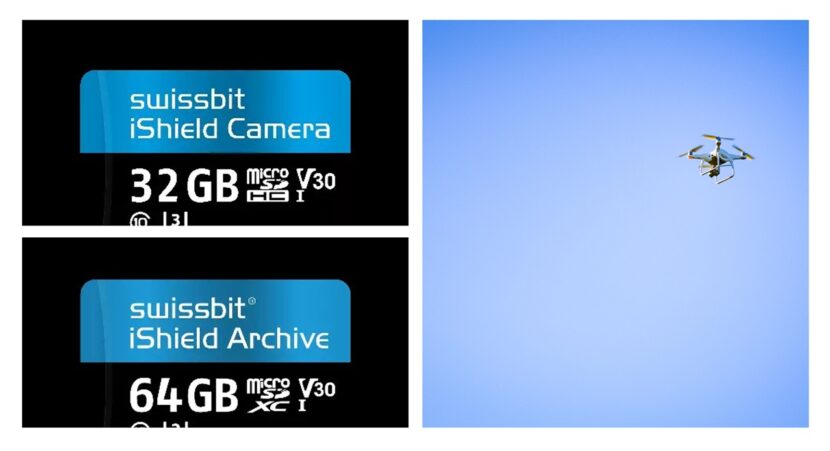
UASs had become a concern not only on the frontlines, but also an unfolding problem in the homefront. As industrial, embedded and mobile systems become ever more connected- they are also more susceptible to hacking and cyber threats. These MicroSD for HLS C-UAS applications solutions are the protection needed for a safer tomorrow. The impact of an exposed system can extend far beyond mundane data loss.
Unmanned Aerial Systems (UASs) uses are now a fact of modern warfare. Extending the frontier to critical infrastructure and to civilian environments. In correlation, Critical Infrastructure Protection (CIP) has become one of the fundamental issues of Homeland Security (HLS). Specifically, the drone sector has become a critical sector within critical sectors. From the US to China, the threat to hack and to breach Unmanned Aerial Systems (UASs) had become a real concern. Even the Swedish military decided to invest billions of Swedish crowns in unmanned systems. UASs are an increasing factor in offensive and defensive operations.
In drones and other mobile edge systems, a cyber breach can mean unauthorized access to logs, video footage, sensor data, or mission information- not only data corruption. Many of the existing systems deployed often rely on removable storage for logs, credentials, configurations, and sensitive operational data. This creates a need for retrofit-ready protection without requiring a hardware redesign. Many UASs are used today in civilian and HLS operations. Mainly in agriculture, logistics, monitoring, surveillance and environmental surveillance. Such systems produce sensitive data such as flight logs, navigation history, video recordings, and sensor readings.
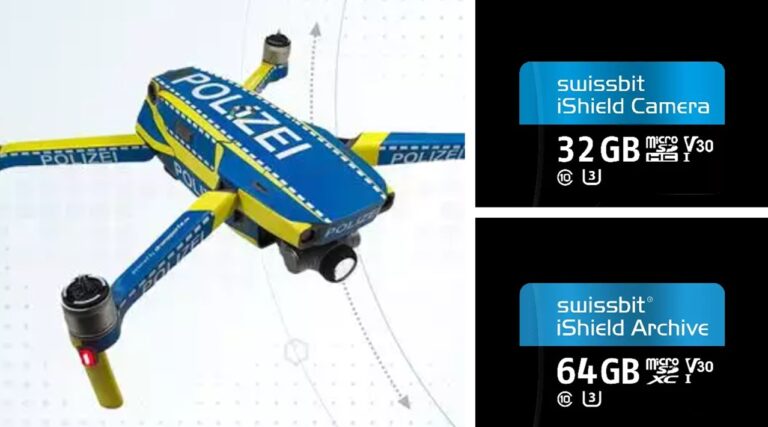
In order to address the security issues of the new HLS UAS sector, E.D.E. Electronics proudly showcases the MicroSD-based solutions, dubbed the iShield Archive and the iShield Camera respectively, for full-scope cyber security for drone application. Made by memory storage and security expert Swissbit, these MicroSD for HLS solutions protect UASs with an encrypted, tamper-resistant storage and controlled access design. Not only that, these solutions offer support for secure boot on Linux-based platforms.
Notwithstanding, these cards are optimal for drone camera, body camera, professional photography (DSLR), dash cam, surveillance camera, action camera, camera traps, and any other monitor application. As attacks on critical infrastructure increase worldwide, one thing becomes abundantly clear: storage can no longer be treated as a neutral component. In our modern connected and AI infused world, a UAS normally includes a flight controller, mission controller, or payload such as a camera or sensor, and a ground control station. Each can become an idle platform for exploitation.
Thus, these MicroSDs for HLS advance the protection of flight data recorders, footage and sensor data. In parallel, they aid to restrict access to mission-critical information without redesigning the architecture.
As they are easy to integrate and replace, MicroSD are the operational standard for embedded and connected devices. In reality, these cards often record much more than what we perceive. They sometimes acquire and record credentials, passwords, tokens and encryption related data, security logs and many more encompassing materials. Due to their nature as removable components, these cards are ripe for cyber-attacks.
An unauthorized individual might manipulate or clone data offline before reinstating it into the system. In industrial and embedded environments, this can undermine reliability and security of the entire system, and beyond. Swissbit’s security upgrade kit was designed to close this gap. It provides a retrofit-ready way to add storage-based protection to existing devices without changing the hardware platform.
Aimed for integration in systems that already use MicroSD storage, these security first storage solutions offer unrivalled modularity and access management capabilities. Based on an automatic lock-and-unlock process, once power is removed or the card is taken out- the protected storage locks automatically. Furthermore, if a card is inserted into another device for inspection, the protected info remains inaccessible.
During boot, the host unlocks it using an authentication method suited to the system design. After the authentication process succeeds, only the storage areas defined by policy become accessible. This allows sensitive data management and access control. As a result, these modules protect credentials, certificates, keys, tokens, and configuration data from offline attacks. Another advantage is that they can also support boot integrity and reduce the risk of software manipulation.
Targeting systems where removable storage holds security, these solutions are ready to be implemented in many deployable spheres. Namely, industrial devices, surveillance systems, IoT gateways, embedded Linux platforms, Unmanned Aerial, Marine and Ground Systems with exposed storage media.
E.D.E. Electronics CEO, Dr. Eran Weis, remarked: “the world of UASs is taking over surveillance applications worldwide. These systems are connected and communicating. However, as greater the connection- so too is the danger within. Therefore, this family of exquisite encrypted, and highly protected, storage solutions are another shield in your application protection. Your Cyber Shield, your iShield”.