
These solutions provide sustained performance, low latency, and low write amplification. These SSD for AI enhanced solutions target apps that require high throughput, low latency, and robust data integrity. Neatly combining PCIe Gen4 performance with industrial design, advanced security features, hardware power-loss protection. Alongside unique controller and firmware expertise. In football, the VAR system reshapes history. Therefore, it needs to be precise, constant and extremely tough.
Football is not a worldwide game, it is a worldwide religion. As in any religion, there could be no place for doubt in rulings. The football world cup comes tonight to its conclusion, but it showcased the vast integration of AI-assisted gameplay. Tech that paved sports history. In recent years, the world of football had become more connected and more tech induced. From a game ball embedded in sensory tech to extract real time data to body cams and player monitoring systems.
Artificial Intelligence (AI) had proliferated in the football worldwide game. All the data collected processed to draw insights, and to quickly determine rulings and the trajectory of the game. Such machinations require operational integrity and performance durability through time.
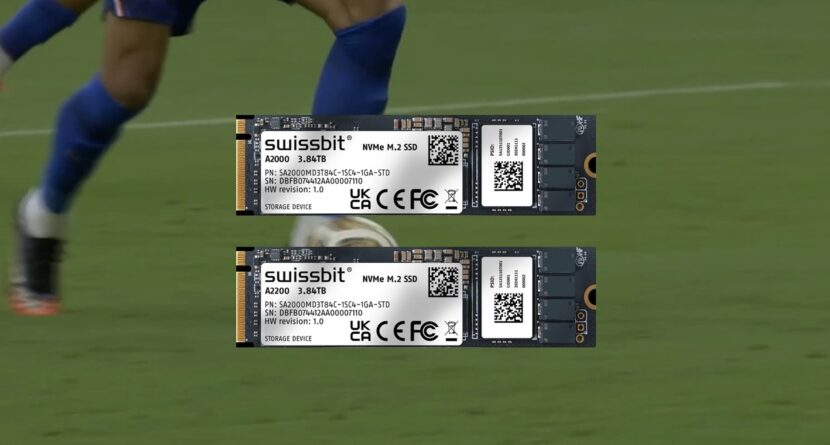
As tech-assisted game rulings can shape fates, so to the endurance of the hardware that provide the benchmark for AI assisted conclusions and decision making. To address this issue, E.D.E. Electronics Ltd is proud to showcase the latest instalment in next Gen Peripheral Component Interconnect express (PCIe) Solid State Drives (SSDs) for AI age. These SSD for AI enhanced solutions, dubbed “A2000” and “A2200” respectively, are designed for mixed-use and write-intensive workloads.
Packed and designed in-house by storage “striker” Swissbit, these solutions are based on the latest BiCS8 3D Triple Level Cell (TLC) NAND modularity. Furthermore, the SSDs use an eight-NAND-channel Dynamic Random Access Memory (DRAM)-based controller architecture and a TLC direct firmware design to deliver sustained performance, low latency, and low write amplification. Additionally, Hardware power-loss protection helps safeguard data without relying on operating-system support, while lifetime monitoring supports preventive maintenance.
Moreover, these memory tech solutions are fully suited for other applications where predictable and consistent performance is critical. Such as high-performance industrial systems, edge AI, networking and communication infrastructure, Internet of Things (IoT) gateways, enterprise servers, medical imaging and data logging.
As AI-based functions are all around us, data-driven rulings and gameplay seem to takeover sports as well. As a result, the quest for more rugged, durable, more protected and reliability driven infrastructure for AI performance is key for better and longer optimum operational performance. As any flaw in data can cause real-life implications. Especially in score-based systems.
Thus, some of the security features of these SSD for AI solutions include AES-256 encryption, TCG Opal 2.0 support, and secure boot. inherently helping protect stored data and device integrity in critical infrastructure and enterprise environments.
In parallel, these splendid memory modules are especially tailored to different apps in the high performance spectrum. Thus, the A2000 is designed for high-end industrial applications with mixed workloads, including boot drives, main system storage, and systems exposed to industrial temperature conditions. Namely, it achieves up to 0.5 drive writes per day.
In continuation, the A2000 and A2200 SSDs are available at launch in the M.2 2280 form factor with capacities ranging from 480 GB to 4 TB, in versions with and without heatsink. More form factors, including E1.S and U.2, will be introduced later this year with capacities up to 8TB.
Meanwhile, The A2200 is tailored to write-intensive and high-endurance applications such as logging, caching, Redundant Array of Independent Disks (RAID)-based systems, and temporary storage. Using enterprise-grade TLC NAND, it achieves more than 1 drive write per day over five years. The A2200/A2000 deliver over 6 GB/s sequential read and over 5 GB/s sequential write performance, as well as over 1M random read Input/Output Operations Per Second (IOPS) and up to 900k random write IOPS. Add to these splendid specifications the explanation of a Beckenbauer. Although it is not “the Kaiser”, he is an innovator in his field.
“After recently introducing the N7000 as our versatile PCIe Core platform, the A2000 series adds a clear high-performance profile to our PCIe portfolio,” says Christoph Beckenbauer, General Manager Memory Solutions at Swissbit. “With DRAM, TLC direct firmware, hardware power-loss protection, and in-house packaged BiCS8 NAND, the A2000 family is designed for customers who need sustained write performance, low latency, high endurance, and enterprise-class features in industrial environments.”
Dr. Eran Weis, E.D.E. Electronics CEO, remarked: “there is no way to ignore the fact that our world is now not only ‘connected’, but AI made. Many of our deductions, conceptions and conclusions are not entirely our own. This Machine Learning based human use has many advantages. But for it to be truly powerful, to be truly a constant presence- it needs the durable. The tough. The tech that can withstand, endure and perform under pressure through time”.
“As Argentine plays again in the world cup, there is one phrase that echoes through the generations. From sport to tech. ‘Football is a simple game. 22 men chase a ball for 90 minutes and at the end, the Germans win” remarked Dr. Weis.