
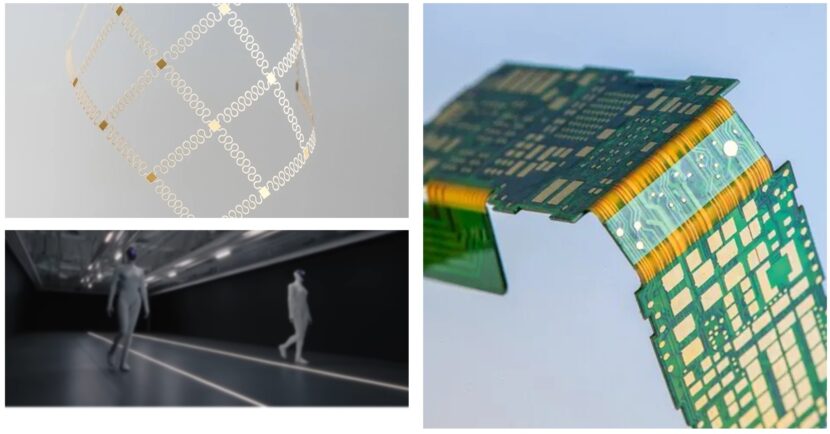
As the miniaturizing processes of industries continue, the need for a more agile, compact and slick PCB is on the rise. The flexible PCB has the ability to be the tough backbone of any system, in a wide range of shapes and forms. This solution caters to a wide array of fields. From IoT and wearables tech to space tech, the flexible PCB lies at their core.
From Wearables, Internet of Things (IoT) devices to Aerospace systems, the flexible Printed Circuit Board (PCB) was at the core of all such technologies. As the general need for smaller devices rises, so does the need for slick, easily morphed adjustable flexible PCBs. Additionally, the flexible PCBs enable tighter formulations in high reliability compositions.
From your smart phone, your medical equipment to automotive- flexible PCBs are implemented everywhere. This rapid integration in multiple sectors relies on the solutions properties to be highly bendable, highly rigorous and highly durable. Thus, making this flexible solution the flexible go-to solution. In recent years, and especially in recent months, there has been talk of humanoid robotics. Some were seen as running short distances. Others folding laundry. Helping in everyday chores. Almost human-like.
Some optimists regard this era as a starting point for non-human domestic help. Such advances were not possible without the flexible PCB formulations. E.D.E. Electronics is proud to present the Liquid Crystal Polymer (LCP) based flexible PCB by tech mindbender DYCONEX. With thinner builds and tighter bends, these flexible PCBs are highly biocompatible as they are made from a Liquid Crystal Polymer (LCP) composite. Furthermore, with more than 10 PCB layers, these excellent PCBs offer almost unparalleled usage of space within the confines of the packaged final product.
Contrary to the traditional PCB, these PCBs are able to bend to your will. Making the integration into varied field not only available but also recommended. As size also matters, these PCBs are offered in 12?m in terms of thinnest standardized board thickness. In continuation, their value for thinnest dielectric thickness stands at 5?m. Easing the use of space in contemporary tech advancements.