
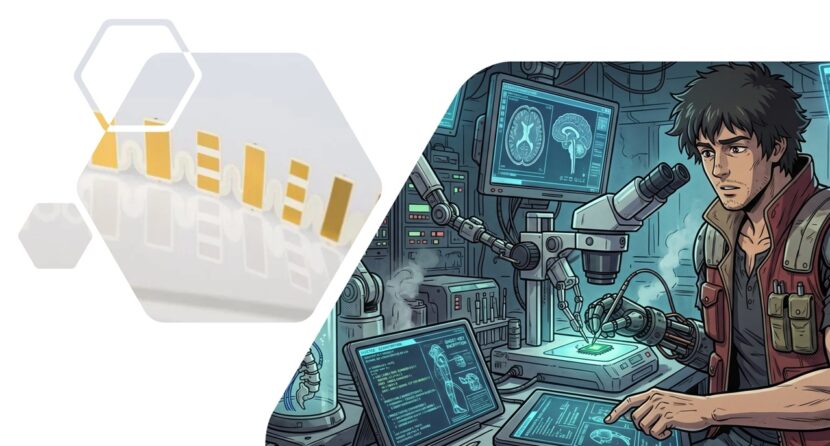
Limb loss often drags with it a multitude of problems. From phantom pains, movement disability to loss of capability. Flexible PCBs are becoming ever more vital in the quest for better treatment for those who experienced limb loss. These HDI and LCP flexible PCBs for Myoelectric prosthetics are ready to advance artificial limbs’ capabilities even further. To mimic the best you can natural operability, you need rugged PCBs that can twist and turn.
Once the subject of Sci-Fi, video games and movie novelty, the intelligent artificial limb solutions are increasingly taking root. It seems that the days of rudimentary prosthetics are nearing their end. be it the cause of warfare, accidents or other medical related issues- limb loss is the cause of many hardships. Such as phantom pains, residual limb health problems and movement disability. Apparently, the prevalence number of traumatic amputation in 2019 stood at 552.45 million worldwide. Not to mention the human cost of ongoing conflicts in Ukraine and the Middle East.
In our AI age, Smart artificial limbs had become ever closer to real limb activity. additionally, They’re not Science fiction turned reality, but they are getting there. Even in Israel interest in such myoelectric solutions is increasing. From specific projects to all new academic degrees. perhaps to be the benchmark for commercial endeavour.
For this evolving market, E.D.E. Electronics Ltd. is showcasing these biocompatible and highly nuanced flexible Printed Circuit Boards (PCBs). Designed and made by E.D.E.’s strategic partner Dyconex, these High-Density Interconnect (HDI) and Liquid Crystal Polymer (LCP) flexible PCBs for Myoelectric prosthetics are fully customizable and highly durable.
Highly rugged and reliability-driven, these flexible PCBs are finely tailored for the medical complexity and sensitivity required for this Smart prosthetics. Especially in Human-Machine Interface (HMI) processes. Bringing man machine relations fantasies into manifestation.
In continuation, the overall system needs to be highly compact in a body-like frame, while adhering to finely tuned almost unnoticeable signals from the user’s own body. Concurrently, one research paper stated that such systems “require reliable, low-noise and high-comfort interfaces between electrodes and the prosthetic system”. Therefore, these flexible PCBs for Myoelectric prosthetics are ready to be integrated in Smart wearables, bionic limbs or Myoelectric prosthetics and even humanoid robotics. Another market which had experienced a recent boom.
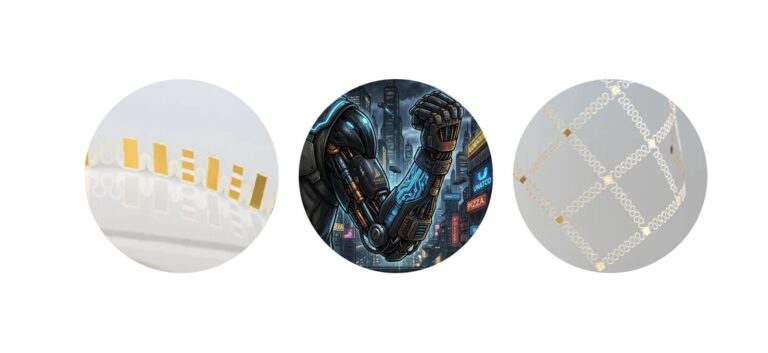
In addition, these LCP PCBs are more suited for biocompatible contact, as they provide extremely low moisture absorption, stable dielectric properties and high chemical resistance. Making them the idle basis for body metrics sensory implementation. For such functionality, the LCP solutions are fully configurable for ultra-thin, extremely dense multilayered designs, while providing consistent electrical and long-term stability. Even in harsh or sensitive environments, including medical and high-frequency systems. These famed and framed solutions are also highly compatible and approved for inner-body implants.
In parallel, were space and performance is of the essence, there you will find these HDI PCBs. By integrating ultra-fine conductor structures with flexible circuit designs, this finely tuned HDI PCB tech manifests highly durable, highly miniaturized extreme conditions electronics structures.